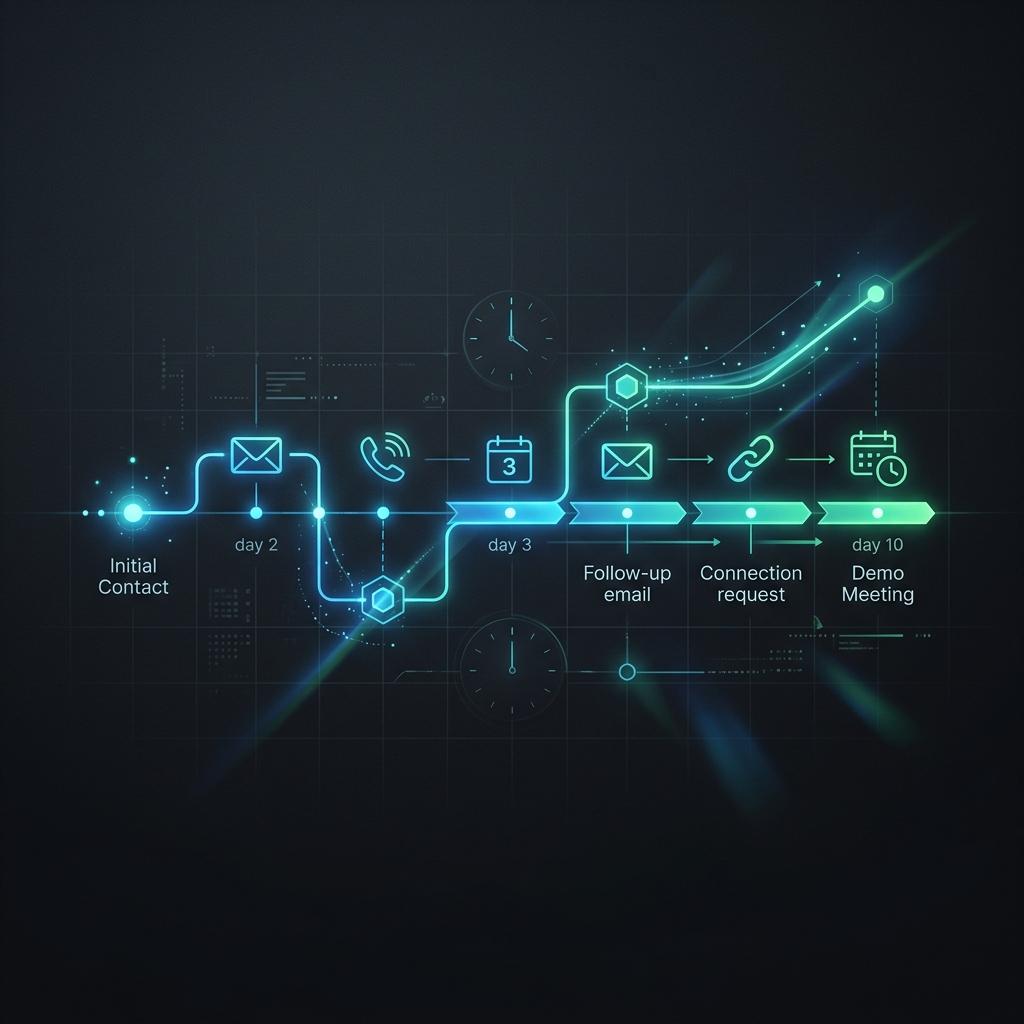
The Experiment That Changed How We Build Campaigns
Two years ago, we ran a controlled experiment across 40 B2B companies. We split each company's target account list into two groups: half received email-only sequences, half received coordinated multi-channel sequences using email, LinkedIn, and phone.
Same ICPs. Same messaging themes. Same send volumes.
Results:
| Metric | Email Only | Multi-Channel |
|---|---|---|
| Reply rate | 4.2% | 11.8% |
| Meeting booking rate | 1.1% | 3.7% |
| Cost per meeting | £520 | £210 |
The multi-channel group produced 3.4x more meetings at less than half the cost per meeting. Not because the emails were better. Because by the time a prospect received the third touchpoint, they already recognised the sender's name.
Recognition is the unfair advantage that multi-channel creates. And recognition is what converts.
Why Multi-Channel Works
When a prospect receives an email from someone they've never heard of, there's a fundamental trust deficit. They don't know you. They have no reason to respond.
Multi-channel sequences systematically close that trust deficit:
- Email reaches them in their professional inbox, high attention context
- LinkedIn appears in their professional network, social context
- Phone is direct, human, and forces a real-time decision
When all three channels are coordinated around the same messaging, the prospect's experience shifts from "who is this?" to "I keep seeing this name, must be worth paying attention to."
That shift from cold to recognised happens faster than most people expect. By touch three, you're no longer cold.
The Framework: Touch-by-Touch
This is the exact sequence we run for outbound campaigns targeting mid-market and enterprise buyers. Timings are from first outreach.
Day 1, Email 1 (Primary)
Purpose: Establish relevance. Create enough curiosity to warrant a reply.
Structure:
- Opening line: A specific observation about their company or industry (not about you)
- One problem you solve, stated in their language
- One proof point, a specific result from a similar company
- CTA: A 15-20 minute conversation, low friction
Word count: 50-75 words. Maximum.
Subject line: 1-4 words. Avoid anything that sounds like marketing.
Day 2, LinkedIn Connection
Purpose: Create name recognition before the follow-up email lands.
Timing: Send the connection request the day after your first email. By the time the connection request lands, they've already seen your name once.
The note (300 chars): Reference something specific about their company. Do not mention the email. Do not pitch.
"Came across your work in the logistics space, specifically the carrier consolidation approach you mentioned in [post/interview]. Would value connecting."
The goal is a simple accept. Nothing more.
Day 4, Email 2 (Follow-up)
Purpose: Add a new angle. Don't just say "just following up."
Structure: A different hook from Email 1. Options:
- A relevant data point from your industry experience
- A brief case study (2-3 sentences, specific to their sector)
- A direct question about their current situation
Word count: 40-60 words. Even shorter than Email 1.
Reference Email 1 briefly: "Sent you a note two days ago about [topic], wanted to add one more thought..."
Day 5, LinkedIn Message (if accepted)
Purpose: Deliver value with no ask. Warm the connection before the phone call.
If they accepted your connection request: Send a brief value message. Share a relevant piece of content, data point, or observation, something genuinely useful for someone in their role.
"Now that we're connected, thought this breakdown of [relevant topic] might be useful given [their company's situation]. No ask, just sharing what we've been seeing."
Response rate on value-first LinkedIn messages: 25-40%. Because there's nothing to resist.
Day 8, Phone Call 1
Purpose: Create a real-time conversation with someone who has now seen your name three times.
The opener: Don't start with your name and company. Start with why this specific company.
"I've sent you a couple of emails about [topic] and connected on LinkedIn, wanted to follow up directly since this tends to be faster. Do you have 90 seconds?"
By this point, 30-40% of prospects will recognise your name even if they didn't reply to the emails. That recognition changes the entire dynamic of the call.
If they don't answer: Leave a voicemail. Keep it under 20 seconds. Mention the emails, give one specific reason this is relevant to them, and your direct number. Nothing more.
Day 12, Email 3 (Case Study)
Purpose: Social proof from a specific, relevant customer.
Structure: Open with the result, not the story.
"A [similar company type] we work with went from £0 in outbound pipeline to £1.2M in their first six months. Happy to share exactly how, worth a quick conversation?"
Specificity is the key. "A company like yours" is weak. "A London-based commercial property company with 40 employees" is compelling.
Day 16, LinkedIn Follow-up (if no reply yet)
Purpose: Last LinkedIn touch before the final sequence.
Structure: A direct, honest message. Reference your previous interactions briefly and ask one specific qualifying question.
"Hey [Name], I've reached out a few times via email and left a voicemail. I don't want to be a nuisance, but I do think there's a genuine fit here. Quick question: is outbound pipeline generation something on your radar for [current period], or is the timing just off right now?"
A yes/no question. Easy to answer. Often gets replies simply because it's direct and human.
Day 21, Email 4 (Breakup)
Purpose: Last touch. Create urgency. Leave the door open with dignity.
"This will be my last note for now, I don't want to fill your inbox. If there's ever a point where building a scalable outbound channel becomes relevant, happy to reconnect. Wishing you a strong [quarter/year] regardless."
Breakup emails often generate the highest reply rate of the entire sequence. Something about finality creates a response.
Day 28, Phone Call 2 (Final)
Purpose: Last human touchpoint.
Short, professional, no desperation.
"Hi [Name], last call from my side. I've reached out a few times about [topic], if the timing ever changes, I'd love to connect. My direct line is [number]. Have a good [day/week]."
Then stop. Continuing past this point damages your sender reputation and professional standing.
The Full Timeline at a Glance
| Day | Channel | Purpose |
|---|---|---|
| 1 | Primary outreach | |
| 2 | Connection request | |
| 4 | Follow-up, new angle | |
| 5 | Value message (if accepted) | |
| 8 | Phone | First call + voicemail |
| 12 | Case study / social proof | |
| 16 | Direct qualifying question | |
| 21 | Breakup email | |
| 28 | Phone | Final call |
Total: 9 touchpoints across 3 channels over 28 days.
Adapting for Your Context
Senior buyers (C-Suite/VP level)
Reduce touchpoints. C-level executives are pattern-matching for time-wasters. They're more likely to respond to 4 well-crafted touches than 9 average ones.
Recommended: Days 1, 5, 12, 21. Longer gaps, higher quality at each touch.
Technical buyers (CTO/Head of Engineering)
Shift from emotion to evidence. These buyers want data, specifics, and proof. Remove any language that feels like marketing. Lead with results, architecture details, and technical specifics.
Small businesses (<50 employees)
Owner/decision-maker is usually the same person. Faster cadence appropriate. Can move from email to phone faster. Often more responsive on LinkedIn than large company executives.
What Kills Multi-Channel Cadences
Inconsistent messaging across channels. If your email talks about one problem and your LinkedIn message talks about something else, the prospect notices. Every touch should reinforce the same core message from a different angle.
Too much, too fast. Sending email Day 1, LinkedIn Day 1, and calling Day 2 feels like harassment. The spacing above exists for a reason, it creates recognition without pressure.
Generic personalization. If your "personalized" opener could be sent to 500 people without changing a word, it's not personalization. It's template copy with first-name merge fields.
Not tracking by channel. If you can't see which touches generated replies, you're flying blind. Track attribution at the touch level, not just the campaign level.
The Multiplier Effect
The math of multi-channel is compelling:
A cold email to a stranger might convert at 2-4%. The same email to someone who already accepted your LinkedIn connection request and recognizes your name converts at 8-15%. The same person gets a phone call, they answer because they recognize the name from their inbox and LinkedIn.
Recognition compounds across channels. Each touch doesn't just add to the previous one, it multiplies the effectiveness of the next.
That's why multi-channel teams consistently outperform single-channel teams by 3-5x at the same volume. Not because they're sending more. Because each touch lands on warmer ground.
If you want to build a coordinated multi-channel outbound programme, not just send more emails, start with a strategy session. We'll show you exactly what the cadence looks like for your specific ICP and market.